
I remember when life used to be more innocent. When we were younger, we weren’t preoccupied with the dismal state of current events. You could argue that they weren’t always so dismal, but I’d retort that current events are always dismal because those are the only current events that get the news media their sweet, sweet viewership. It’s much easier for me, in the current event that is this warm Saturday morning, to reflect on the time where the next day’s outfit or the decision of whether to ask out the girl I liked were the most difficult conclusions facing me.
Vampire Weekend’s music was intertwined with that period in my life, and perhaps most appropriately so. I was much more preppy back then, sporting cardigans and newspaper glasses and trying much harder to fit in. Ezra Koenig’s ivy league aesthetic was my calling card, and my love for his band’s music just naturally fell into place. I’m not sure if it was college, gradual detachment from my old friends, or some other combination of life experiences that made me much more cynical over the years. But that cynicism gave me new appreciation for Vampire Weekend, because I realized that their music was just pretending to be carefree, and rather was sarcastic system donned in a healthy sheen of strings, Epiphone guitar solos, and a Paul Simon-influenced springiness.
Nowhere was this appreciable two-faced music more present than on Vampire Weekend’s 2013 album, Modern Vampires of the City. The hipster college party vibe of their first two records was replaced with a set of more serious songs written as something of a “breaking up with God” anthology. Songs like “Unbelievers,” “Everlasting Arms,” “Worship You,” and the epic “Ya Hey” tied it all together, and after “Ya Hey” came “Hudson,” the blackest song the band has ever produced (by far). MVotC marked a coming-of-age for the band, and perhaps left them in a state of “what’s next?” following the release and ravenous acclaim for their magnum opus.
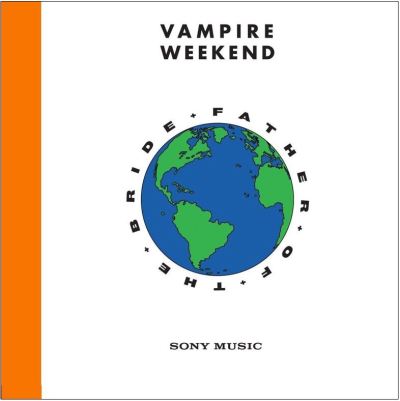
This all begs the question: “Do we really need another Vampire Weekend album?” Fans such as myself initially demanded it, but my own personal need for it dwindled as the release of Father of the Bride grew nearer. What more could Vampire Weekend say that would be as clever, relatable, or controversial? Perhaps I was just past the point in my life where an album that was originally going to be called “Mitsubishi Macchiato” would really do a lot for me.
I’m currently in the middle of my sixth or seventh listen of Father of the Bride, and to be honest, the jury is still out on whether I think it’s a masterpiece, a steaming trash pile, or something in between. But I still feel confident enough to review it now because an album that I listen to more than five times and still am not sure about is certain to exist in a perpetual state of volatility in the critic’s center of my brain.
If I’m sure about anything regarding Father of the Bride, it’s that Vampire Weekend sounds like Paul Simon more than ever. They’ve unapologetically embraced their most obvious influence, and I guess that’s a symptom of a larger pattern: Vampire Weekend is the most “themselves” they’ve ever been. Father of the Bride marks a transition from an awkward state of uncertainly and emotional turmoil to a more comfortable attitude of “Fuck it, I’ll do what I want.” And I suppose that’s what I appreciate the most about this album.
I’ll admit, when I turned on Father of the Bride for the first time and heard the seemingly unfinished “Hold You Now,” I had a bit of a “Oh God, oh fuck!” moment. This is what I’d waited six years for? But the transition into “Harmony Hall” really tied it all together, though it took me a few listens to really appreciate them as a perfect pair.
The “unfinished” quality of Father of the Bride is still the thing that bothers me the most about it. You could argue that it’s just Vampire Weekend going in the more stripped-down direction, but songs like “2021” and “Big Blue” feel like ideas for great songs that got put on the album as just ideas. Especially when contrasted with beautifully fleshed out songs like “Harmony Hall” and “Married in a Gold Rush,” these songs feel like demos, which I’m generally not a fan of on studio albums.
While I do appreciate Vampire Weekend taking a more selfish approach to their song writing, the album as a whole feels much less coherent as a result. The back-to-back combination of “Sympathy” and “Sunflower” makes very little sense to me. While MVotC had plenty of variety on it, the variety felt a lot more logical in relation to the emotional rollercoaster of that particular album.
I almost hate to compare the two, because the motivation behind the two records feels so very different. Just as it might be fruitless to compare David Bowie’s Let’s Dance with, say, Blackstar, it might be fruitless to compare Father of the Bride and Modern Vampires of the City. But this analogy fails to hold its weight because Vampire Weekend practiced radio silence between their pair of remarkably different ideas.
Father of the Bride still has its somber moments, such as its closer “Jerusalem, New York, Berlin.” However, that somberness comes from a very different place. Rather than a frustration that a long-term love has failed, it’s an acceptance that love isn’t always meant to be. Father of the Bride is also much more down-to-earth and doesn’t tackle the real deep issues.
Ultimately, Father of the Bride is like a lot of other albums: it’s about a girl. Danielle Haim is featured on several songs throughout the tracklist, playing the role of this girl. Her presence on Father of the Bride is one of the album’s best assets, really tying it all together. While the girl and the boy don’t ultimately end up in the same place, Father of the Bride does do an excellent job of documenting their journey. It took me four or five listens to really appreciate this, but once I did, it caused the album to really grow on me.
Who knows, I could have it all wrong. But the beautiful thing about art is that even if the artist explicitly states his source of inspiration (which is rare), people will still find their own meaning, and there’s absolutely nothing wrong with that. And like I said, the album’s meaning and my personal assessment of its quality still isn’t set in stone.
Now that I am a little bit older, and my days of innocence and cardigans are behind me, an album like Father of the Bride ends up being a little more appropriate than I expected. Vampire Weekend might still be a bunch of east coast rich kids, but they’re much older kids now, who’ve seen some shit. And that reality comes across clearly on Father of the Bride. Like myself, Vampire Weekend has stopped caring about what they wish they could be and are more in touch with what they are. And sometimes, being a little bit selfish in this dog-eat-dog world is necessary to survive.
The world still is becoming less and less innocent everyday. And while some find meaning in confronting the terrors of life head-on, others, like myself, find peace in just tuning out some of the noise and shrinking their milieu to a more manageable size. Father of the Bride takes this second approach, and while it’s somewhat inconsistent, it still has some of Vampire Weekend’s best songs to date, and offers a little escape from the misery that surrounds us.
Ryan’s Score: 6.9
 Ryan Reviews Music